A patient sits down and tells you she is menopausal. She asks whether you can help. You refer her out, because you are not sure you know this well enough. Then a familiar thought arrives: maybe one more course will fix it.
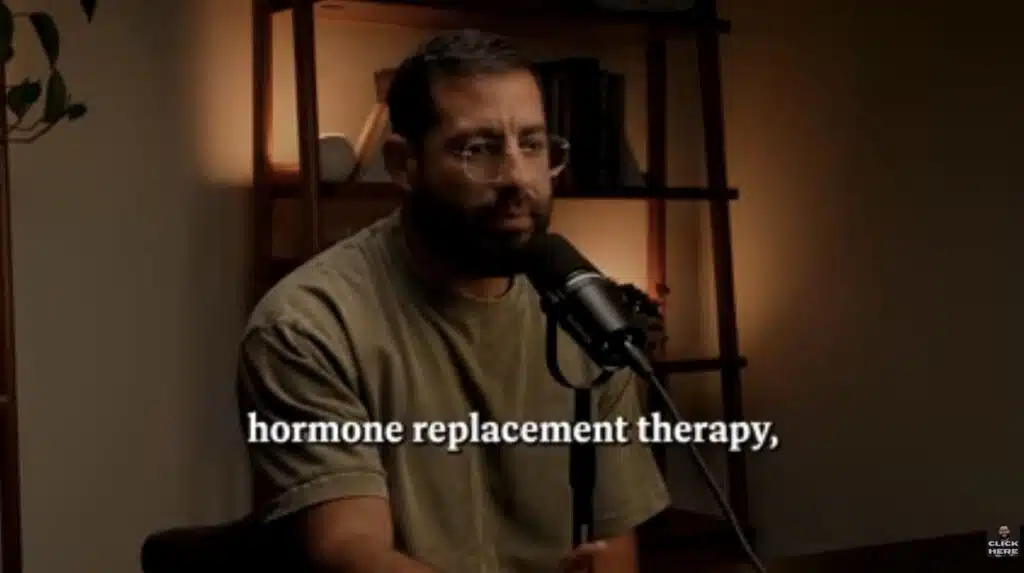
In Episode 115 of the HRT University Podcast, Nico Misleh, MSN, FNP-C, makes the case that another course rarely fixes that uncertainty. The gap is clinical reasoning. Clinical reasoning in HRT means you can explain why a hormone does what it does. That understanding holds a decision together when a patient does not fit the protocol.
What is clinical reasoning?
Clinical reasoning is the thinking a clinician does between gathering information and acting on it. According to the University of Iowa’s internal medicine program, it shapes every task in a visit, from the history to the prescription. The program frames it as what physicians think about and how they think.
The same program describes two processes. The first is fast and intuitive, and experts lean on it most of the time. It matches the patient in front of you to an illness script from cases you have seen before. The second is slower, more deliberate and more reliable. Most errors happen in the fast one.
In hormone therapy, fast pattern matching is only as good as the patterns underneath it. If those patterns came from a dosing chart, they hold for the patient the chart describes. They give way for everyone else.
Why do HRT courses teach protocols instead of clinical reasoning?
A year or two into learning hormone therapy, Nico started shopping for courses. They ran from a few hundred dollars to several thousand. He remembers sitting with his credit card out and stopping. Looking back, he can name the pattern that stopped him.
“Whether it was a $200 course or a $7,000 course, they more or less had the same dosing charts,” he says. Most also shared similar lab reference ranges and the same consensus on who counts as a candidate. Each program repackaged that material under a new name.
The courses also framed hormone therapy around patients 45 or 50 and older. Across the table from his own patients, Nico sees men and women in their 20s and 30s whose levels are “atrocious.” No course he found asked why. He bought one anyway. He finished it, in his words, with a lack of confidence and a little bit of disappointment.
His explanation is that much of HRT education copies conventional medical training, which runs on algorithms and standardization. Algorithms work well for problems that look the same from patient to patient. His example is appendicitis. Right lower quadrant tenderness, fever and a few hours of pain lead to a CT scan. Surgery then follows a set sequence, down to the incision and the antibiotics.
Standardizing that process helps patients. Hormones and chronic disease are a harder kind of problem. The systems are complex and they interact, and the patient in front of you rarely matches the textbook case behind the protocol. Two hospital-trained physicians made a related case on the podcast about how little medical training covers sex hormones. Another episode covers the cost of over-relying on clinical guidelines.
Does more HRT training build prescribing confidence?
The assumption under every extra course is that more information equals competence. Nico says he sees it a lot, and he held it himself. He calls himself a brainy guy who loves reading, and he believed that taking in more would make things better.
“The quantity of information is not going to save you,” he says. “The quality of that information will.”
A course might run two hours or 200, and the length did not track with confidence. Volume without structure can leave a provider more confused than before.
His image for this is a filing cabinet. Without a framework, a new study has nowhere to go, so it lands in a mental junk drawer. With a physiology-first framework, each new piece has a place. It confirms what you already understand, refines it, or contradicts it and forces an update.
That is also why a third or fourth course can add confusion. Many courses repeat the same consensus with small changes. A provider ends up comparing near-copies and wondering whether any of the differences matter.
What does clinical reasoning look like with progesterone?
Progesterone is Nico’s example. Most HRT courses teach how to dose it, and many do that part well. Few teach what progesterone is, what it does across the lifespan in men and women, or how it connects to other hormones.
None of the courses Nico tried taught that material, so he went to the physiology literature. He read back to the biologists and chemists of the 1920s and 1930s and later, including Otto Warburg and Ray Peat. His goal was to understand energy and metabolism.
Knowing what progesterone is changes the clinical picture. Progesterone converts to allopregnanolone, a neurosteroid that acts on GABA-A receptors. That pathway helps explain its effects on sleep, stress and mood. A provider who prescribes it only for endometrial protection is working with half the picture. HRT University has covered this in more depth in the benefits of progesterone in women and men and in In Defense of Progesterone.
The same understanding opens up patients a menopause protocol never mentions. Nico points to women under 45 with irregular cycles, heavy periods, insomnia or anxiety, and to postpartum mood symptoms and PMDD. A protocol written around one menopausal case gives a provider no way to reason about them.
“The principles are much greater than the protocols,” Nico says. “It is the principles that drive the protocols, or even change them.”
Is a physiology-first approach slower than following a protocol?
The objection Nico expects is time. A provider who sees patients all day, or runs a clinic, wants something practical. He calls himself pragmatic and agrees that the upfront investment is real.
His answer is that the framework is faster in clinic. Once the reasoning is in your head, he says, decisions take seconds. You stop checking a dozen references to feel sure. It is the same fast, intuitive process the Iowa program describes, with physiology underneath it.
Protocol-only training is what costs time. Nico’s guess is that the HRT courses a typical provider has stacked up already add up to 60 hours or more. Every patient outside those protocols still turns into an ordeal or a referral. Each one becomes a fresh source of uncertainty, and that is what slows a practice down.
How do you build clinical reasoning in hormone therapy?
Nico has a suggestion for the next clinic day. Before you look for the next course, ask why of the material you already have. Ask why a dose makes sense and what the hormone is doing in this patient. If the material cannot answer, you have a quality problem, and more volume will not solve it.
He is not telling anyone to stop taking courses. His advice is to be careful about buying a course to fill a need it was never meant to fill.
“Mastery is not and will never be the sum of every course you have taken,” he says. In his view, the framework is what makes the next course mean something.
Most providers met this gap in their first days of clinical training. Real patients matched none of the algorithms from school, and they had to think. A hormone practice asks for the same thing every day.
The goal Nico describes is competency first. Confidence follows it. A provider who understands the physiology of progesterone, testosterone, thyroid and DHEA can reason through the case in front of them. That holds for a patient of 24, 44 or 84.
Listen to Episode 115
Spotify embed: Episode 115 on Spotify
YouTube embed: Episode 115 on YouTube
The full episode runs about 32 minutes. Nico goes deeper on the course comparison, the appendicitis example, progesterone and the time objection.
Frequently asked questions
What is clinical reasoning in hormone therapy?
It is the process of moving from a patient’s labs to a plan by reasoning through physiology. In hormone therapy, it means knowing why a hormone acts the way it does. A plan built that way still makes sense when a patient falls outside a protocol.
What is the difference between clinical reasoning and critical thinking?
Critical thinking is the general skill of analyzing and evaluating information. Applied to one patient, it becomes clinical reasoning, which leads to a diagnosis and a plan.
What is the difference between clinical reasoning and clinical judgment?
Clinical reasoning is the process, and clinical judgment is the decision it produces. Better reasoning gives that judgment a sounder base.
What are the two processes in clinical reasoning?
One is fast and intuitive and matches a patient to a familiar pattern. The other is slower and analytical. Experienced clinicians use the fast one most of the time, so the patterns behind it need to rest on sound physiology.
Why do providers still feel unsure after HRT training?
Many HRT courses teach the same dosing charts, reference ranges and candidate criteria. Few teach why those numbers make sense. Without that, every patient outside the protocol brings the uncertainty back.
Are HRT protocols wrong?
Protocols are useful starting points. Nico’s position is that principles drive protocols, and sometimes change them. A provider who knows the principles can adjust when a protocol does not fit.
Is a physiology-first framework slower in clinic?
Nico argues it is faster. The upfront study takes time. Once the reasoning is in place, decisions take seconds instead of a search through references.
What does progesterone do beyond the uterus?
Progesterone converts to allopregnanolone, which acts on GABA-A receptors in the brain. That is part of why it can affect sleep, stress and mood. Its role also extends to men and to women of every age.
Who is this episode for?
It is for licensed prescribers who want to understand the physiology behind hormone therapy. Nico says it will not suit a provider who is happy with 15-minute visits and 30 to 40 patients a day.
Where does HRT University teach this framework?
Nico teaches it in the HRT University Master Course, which opens with the foundations of hormone and metabolic physiology. Providers earn 30 CE hours, including 12 hours of pharmacology.
Learn the reasoning behind the protocols
Nico teaches this framework inside the HRT University Master Course. It starts with energy, function and metabolism, then works through male and female hormone therapy, thyroid and adjunct hormones. Pinnacle Conference, LLC is jointly accredited by ACCME, ACPE and ANCC and is the accredited provider. HRT University plans and implements the course, and providers earn 30 CE hours, including 12 hours of pharmacology.
Nico also covers prescribing questions like this one in The Second Opinion, his free newsletter. More episodes are on the HRT University Podcast page.
References
University of Iowa Carver College of Medicine, Department of Internal Medicine. Clinical and Diagnostic Reasoning.