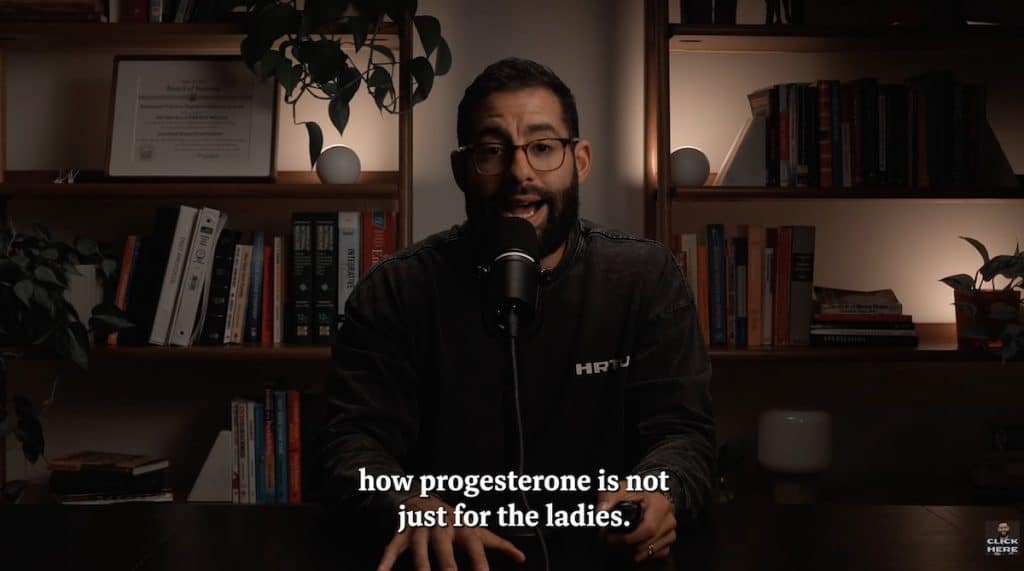
Progesterone got filed under women’s health. Then, inside women’s health, it got filed again, under the uterus. That second filing is the one that does the damage.
If you’re prescribing progesterone for endometrial protection, good. That part’s real. Unopposed estrogen carries risk in a woman with an intact uterus, and progesterone handles it. But you’re working with about a quarter of what this hormone actually does. And if you’re not prescribing it to male patients at all, you’re working with less than that.
Progesterone is probably the most underrated and mischaracterized hormone in clinical practice.
What Are the Benefits of Progesterone?
Progesterone improves sleep, reduces anxiety, steadies mood, protects brain tissue against Alzheimer’s and dementia, supports cardiovascular health, and supports sexual health. It also protects the endometrium in women. These functions run in both men and women.
Calling endometrial protection progesterone’s job is like saying the point of sleep is to rest your eyes. Sure, your eyes get a rest. That’s the cherry on top. It misses everything that matters.
Why You Were Never Taught This
Progesterone isn’t taught in any real detail in any of our schooling. It doesn’t matter where you went. It’s not well studied and it’s not well discussed in terms of what it actually does across the system.
The research is part of the problem. Most of it was done in female populations and framed inside reproductive medicine, so it never reached out into the other specialties where progesterone matters.
And then it gets worse. The literature keeps combining progesterone with progestins and using the words interchangeably. That’s like running a study on apples and oranges and calling them the same thing. Both fruit. Completely different outcomes.
The Brakes and the Gas Pedal
Here’s the analogy I use, because it’s the whole story in one picture.
GABA is the brakes of the brain. Glutamate is the gas pedal. You need some of both every single day.
Now take the brakes away. The gas pedal didn’t change and the engine didn’t get bigger, but you can’t slow down and you can’t stop when you want to. That’s your anxious patient who can’t fall asleep.
If you have a progesterone deficiency, you’ve essentially got a GABA deficiency. And what are the common signs of progesterone deficiency? Anxiety. Irritability. Trouble sleeping. It tracks.
Allopregnanolone, the Metabolite Nobody Learned
Progesterone converts through 5-alpha reductase into allopregnanolone, a neurosteroid. Allopregnanolone is a positive allosteric modulator at GABA-A receptors, so progesterone is indirectly strengthening inhibitory signaling in the nervous system.
When GABA signaling is robust, the nervous system can downshift. Anxiety, irritability, and sleep onset all improve.
Allopregnanolone binds a site on the GABA-A receptor that’s separate from where benzodiazepines bind. It’s one of the most powerful endogenous GABA-A modulators we know of, and your body makes it directly from progesterone.
Pharma Understood This Before We Did
Here’s where it gets interesting. Pharmacology recognized this system and understood it better than we give them credit for.
Instead of using the natural metabolite, or just using progesterone in a woman with anxiety who’s clearly progesterone deficient upstream, the move was to work out exactly what allopregnanolone does at that receptor and then patent something that looks a lot like it.
In 2019 the FDA approved brexanolone for postpartum depression. In 2023, zuranolone. Both mimic allopregnanolone’s GABA activity. The FDA approved drugs designed to replicate what progesterone already does through allopregnanolone.
You’ve probably never heard of either one, because they’re new and they’re extraordinarily expensive. We’re talking thousands of dollars for a dose. Meanwhile progesterone, which works perfectly well for these same problems, is bioidentical and can’t be patented. There’s no money in a hormone nobody owns.
And the clinical default for sleep disruption, anxiety, irritability, and agitation is still an SSRI or a benzodiazepine. Does a benzo work? Amazing, incredible. Is it the appropriate therapy? No. We know from the literature that benzodiazepines raise the risk of alcoholism, and dependency is baked into them.
The patients who’d benefit are sitting in your waiting room right now. They’re the ones telling you they don’t have major depressive disorder and they’ve never been anxious in their life. They’re just struggling. And a lot of the time they need a hormone their own system has run out of.
Progesterone Is Not a Progestin
This one matters more than almost anything else on this page. Burn it into your brain.
Take medroxyprogesterone acetate, MPA, probably the best known progestin in the world and at one point the most commonly prescribed. It is not progesterone. It’s a hormone-like substance, and its backbone is closer to testosterone than to progesterone.
It cannot convert to allopregnanolone. That pathway doesn’t exist from MPA. It also binds androgen receptors, glucocorticoid receptors, and mineralocorticoid receptors, which is why patients on MPA get complaints that patients on progesterone simply don’t get. Mood disruption, bad fluid retention, androgenic side effects, and sleep and anxiety that never resolve, because they aren’t getting the hormone they actually need.
Most patients on bioidentical progesterone rarely have side effects at all.
Progestins are also what carried the worst of it in the trials. The clotting, the cancers, the strokes, and the signal toward Alzheimer’s and dementia were most heavily associated with progestins.
When we say progesterone, we should always mean bioidentical. When we say progestin, we should never mean progesterone. If someone needs an apple, we don’t hand them an orange. We have apples. The pharmacology is laid out in Progesterone vs. Medroxyprogesterone Acetate: What the Pharmacology Actually Shows.
Benefits of Progesterone in Women, Beyond the Uterus
Sleep. Progesterone improves sleep architecture. It improves deep sleep through allopregnanolone, and it’s a beautiful thing to watch, especially in women in menopause and beyond who have no progesterone left. Ask any woman in her fifties or sixties how she’s sleeping. It’s terrible. She wakes frequently and she often wakes up anxious. That’s 99 percent of the time, and it’s the missing progesterone and allopregnanolone.
Mood. Add progesterone back and you get mood stabilization. The anxiety dampens because you’ve restored GABA modulation. And some women do sleep through the night and still wake unrested and a little anxious. If you’ve ever gone a few days on bad sleep you know exactly how that feels the next day. It isn’t a coincidence. Improve sleep and the GABAergic system and moods improve.
Luteal phase support. This isn’t only for women past menopause. In women still cycling, the progesterone deficiency in the second half of the cycle drives PMS, severe PMS, PMDD, and general cycle-related mood disruption. Young women come in for mood and behavior, and instead of throwing birth control at them or calling it major depressive disorder and adding an SSRI, get to the root. Low progesterone. Give progesterone. They feel great, and their outcomes are better, not worse.
After menopause. What you’ll hear is that this is just for the uterus, so at your age you don’t need it anymore. It’s pointless. You’re not having a baby. That’s like a dentist telling a sixty-year-old not to bother brushing because he won’t be around that much longer. Forget that part of your body, you’re not really using it. It makes no sense. Healthy teeth prevent a lot of problems, and a healthy uterus matters too. Progesterone goes way beyond the uterus. More on prescribing in hormone replacement therapy for women.
Benefits of Progesterone in Men
Men make progesterone. This isn’t controversial, it’s basic endocrinology. We don’t make a lot of it, and we don’t use it in the same capacity women do, but many of the functions mirror what women get from it. Which makes sense, since we’re both human beings.
Neuroprotection. Progesterone has been shown to be neuroprotective in both animal and human studies. There isn’t a large male literature, but what’s there is solid and the animal data supports it.
Sleep and anxiety. The allopregnanolone pathway works essentially the same way in men. Male patients on progesterone often report better sleep and less anxiety.
Cortisol. Progesterone competes with cortisol at the glucocorticoid receptor, so adequate progesterone blunts some of those downstream effects. More on that in cortisol and hormones.
Prostate. Progesterone opposes the stimulating effects of DHT and estrogens at the prostate. To be clear about what I’m not saying: DHT does not cause prostate cancer. It does tickle the prostate. And the fear that progesterone somehow feeds prostate cancer has no real mechanistic support.
Progesterone in Men Is Testosterone in Women
The comparison is almost exact. The messaging around women and testosterone has always been that they don’t need it, that it isn’t their major sex hormone, that estrogen is. Which, in my opinion based on the literature, it isn’t. It’s progesterone. Estrogen is secondary.
There’s still no FDA-approved testosterone product for women in this country. Zero. And yet women produce testosterone, point for point more than nearly all their other hormones.
Flip that same understanding over to men and progesterone. Once you see that progesterone in men is treated exactly the way testosterone in women is treated, you realize we could probably be using it a lot more than we do, and the only thing stopping us is fear.
Which Men Benefit Most
You’ll have guys who are on testosterone, whose thyroid you’ve got figured out, who are doing well, and who still sleep like crap, still feel anxious, and still aren’t recovering the way they should. Progesterone is frequently part of that answer.
The men I reach for it in most are men with anxiety, men with a traumatic brain injury, men with PTSD, and men with BPH. PTSD is probably the population where it’s most striking. Ex-Marines, firefighters, police. Also patients after bad motor vehicle accidents who can’t get comfortable behind the wheel again, which is embarrassing and hard for them. Oxytocin also has a role in PTSD, though I lean on progesterone more at this point.
Dosing is different in men, and it’s much lower. Most men do not need 200 mg. Oral micronized progesterone makes sense for the anxious man who doesn’t sleep well, because that first-pass trip from mouth to gut to liver is what produces allopregnanolone. I go into dosing in detail in the adjunct hormone module of the HRTU Master Course.
Worth knowing that DHT also has a GABAergic effect in men, which is part of why so many men with anxiety and low mood do well on testosterone replacement alone. Progesterone is for the percentage who still don’t get that last 20 or 30 percent out of their system.
I’ll be honest, I underutilized progesterone in men for years. I was almost scared of it, like it was going to mess these guys up somehow. Every time I’ve used it, it’s been nothing but glorious. I had to get past my own bias, and you can too.
Answering the Objections
It’ll destroy libido and erectile function. At really big doses, sure, that could happen. I’ve never seen it in any of my guys, and I don’t dose it that high. We’re not giving men female doses. I don’t give women male doses of testosterone either, because they don’t feel good and they get side effects.
It causes inflammation. Not true. Progestins do. Men get given progestins in a study, the result gets attributed to progesterone, and now men supposedly shouldn’t take progesterone. Progesterone is broadly anti-inflammatory across sexes and across species.
It’s just my opinion. It isn’t only me anymore. Plenty of colleagues and HRTU students are prescribing progesterone to men and finding the same success, which tells me the landscape is shifting.
Where This Shows Up Next
There’s more here than one episode covers. Progesterone for PMDD. OCD, and I think OCD in men can be helped a lot by progesterone too. Catamenial seizures, the ones that cluster around the luteal phase in women. And if progesterone helps seizures in women, what about men with seizures, or men with a brain injury and inflammation in there? We know progesterone calms the central nervous system and may protect and support brain tissue.
These patients get bounced between neurologists and stacked on anti-seizure medications that are devastating to the metabolic system. They crush metabolism, they cause fatigue, weight gain, and low mood. I’m not saying pull anyone off their medication. I’m saying we need to be more vocal, because it’s hard to wait for the literature to catch up while patients are struggling in front of us.
Same goes for the SSRI reflex. So many of your patients are on an SSRI for anxiety, sleep, or depression. Maybe it helps some. It isn’t getting to the root, and SSRIs generally worsen metabolic health going forward. The underlying problem in a lot of these cases is progesterone deficiency and GABA insufficiency.
And I’m not anti-psychiatry. Some of my most effective students come out of the psych world, precisely because they can see how small the toolbox was and how much endocrinology was left out of it.
Frequently Asked Questions
What are the benefits of progesterone?
Progesterone improves sleep and deep sleep quality, reduces anxiety and irritability, steadies mood, protects brain tissue, supports cardiovascular and sexual health, and protects the endometrium in women. Most of the neurological benefit comes from allopregnanolone, the neurosteroid progesterone converts into.
Is progesterone only for the uterus?
No. Endometrial protection is real, but it’s roughly a quarter of what progesterone does. The sleep, mood, brain, cardiovascular, and sexual health functions don’t depend on having a uterus or on being fertile.
What is allopregnanolone?
A neurosteroid made from progesterone via 5-alpha reductase. It’s a positive allosteric modulator at GABA-A receptors and it binds a site separate from where benzodiazepines bind. It’s one of the most powerful endogenous GABA-A modulators known.
Why do anxiety, irritability, and poor sleep happen together?
Because a progesterone deficiency is effectively a GABA deficiency. GABA is the brain’s braking system. When progesterone and allopregnanolone drop, inhibitory signaling drops, and everything that depends on being able to downshift suffers at once.
Is progesterone the same as a progestin?
No. Medroxyprogesterone acetate has a backbone closer to testosterone, cannot convert to allopregnanolone, and binds androgen, glucocorticoid, and mineralocorticoid receptors. Progestins carried most of the clotting, cancer, and stroke signal in the trials. Progesterone and progestins are apples and oranges.
Do postmenopausal women still need progesterone?
The argument that they don’t assumes the uterus was the point. Sleep, mood, brain, and cardiovascular benefits continue regardless of fertility.
Do men need progesterone?
Men make progesterone, and many of its functions mirror what women get from it. It comes up most in men with anxiety, traumatic brain injury, PTSD, or BPH, and in men whose testosterone and thyroid are handled who still sleep badly and still feel anxious.
Does progesterone lower libido or cause erectile problems in men?
At very high doses it could. That isn’t how it’s dosed in men. Male doses are much lower than female doses, the same way you wouldn’t give a woman a male dose of testosterone.
Does progesterone cause inflammation in men?
No. That claim traces back to studies using progestins and then attributed to progesterone. Progesterone is broadly anti-inflammatory.
What dose of progesterone do men need?
Much lower than women. Most men do not need 200 mg. Oral micronized progesterone is useful when the goal is sleep and anxiety, because first-pass metabolism from mouth to gut to liver is what generates allopregnanolone. Specific dosing is taught in the adjunct hormone module of the Master Course.
Related Reading
- Should Men Take Progesterone?
- Progesterone vs. Medroxyprogesterone Acetate: What the Pharmacology Actually Shows
- Progesterone and Brain Health: Debunking the Cognitive Decline Myth
- Cortisol and Hormones: What the Physiology Actually Shows
- Hormones and Depression: Why SSRIs Are Not the Full Answer
- Progesterone and the Gut
I go into all of this in far more detail in the HRTU Master Course, and it helps because it ties together. Six modules, thirty CEs, jointly accredited. If you’re newer to this, start with HRT training for nurse practitioners and providers. Every episode is on the HRT University Podcast page.