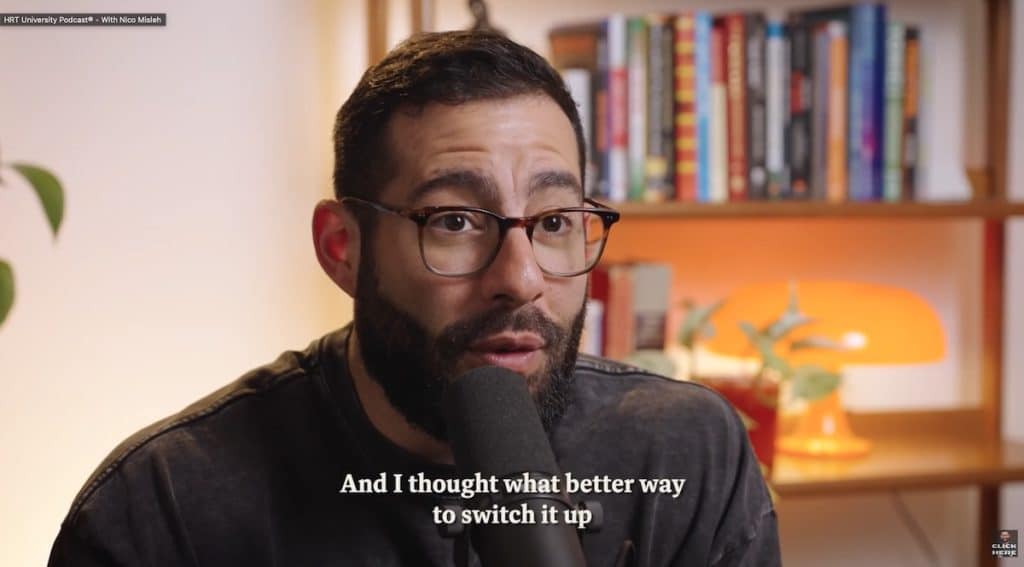
I want to talk about the stuff nobody told me when I was building my own clinic. Most of what providers get told about how to build a cash-pay HRT clinic is backwards. I learned that the hard way.
I have owned Apollo Health Optimization for going on three years now. Before that, I had a 1099 part-time clinic doing functional medicine, so call it five years total of doing this on my own. Professionally and personally, it has been the best decision of my life. One I would never go back on.
But I also know how easy it is to approach this whole thing backwards. I consult with clinic owners constantly, and the thinking usually goes one of two ways. The first is the Field of Dreams version: build the practice first, get the patients in the door, and figure out the clinical stuff as you go. The second is the aesthetics-clinic version: hire someone who knows HRT and just handle the business side yourself.
On paper, both make sense. The business side feels learnable. There is a marketing playbook for it. Social media has a formula. Branding is a whole industry. You can buy your way into the patterns. The clinical mastery feels like the opposite. It feels enormous, an overbearing weight that takes years, and nobody handed it to you in school. We were taught maybe this much about hormones in NP and PA programs, and we all know now we were not taught it well at all.
So providers do what feels manageable. They build the business side and treat the clinical foundation like something they will catch up on once the patients are flowing in.
That is the part I want you to understand differently. The clinical foundation is not a prerequisite for the cash-pay HRT clinic. It IS the cash-pay HRT clinic. They are not different. They are not separated. They are the exact same thing. That is the product.
The mug analogy: clinical mastery is the business
If I have a mug in front of me, the mug is the product I am trying to sell. If I want a real business, one that is going to stand the test of time, I am not making a shitty mug. I am using really good materials. I am picking colors that look good. I am making sure it is ergonomic. I am making it as good as I possibly can, because the mug is the business.
You do not build a business around a really bad product. That is the whole thing.
In an HRT clinic, the mug is what you know and how you apply it to patients sitting in front of you. That is your product. Everything else, the website, the funnel, the Instagram, the ad agency, is a wrapper around it. If the mug is bad, the wrapper does not matter.
When people ask me about the cash-pay HRT clinics that are doing well, I tell them the ones I know are not built on marketing. I did not do traditional marketing at Apollo. I never paid for an ad agency. I did not do social media for years. I did boots-on-the-ground work and networking and that was it. It was not a strategy. I did not need one.
What my business was built on, and what it is still built on, is clinical depth that patients can feel.
Why patients can feel the difference
You have been the patient at some point. Almost everyone has. Imagine something traumatic happens and you have to go in for an operation. You meet the surgeon. If that surgeon feels in any way not so confident in what he or she is about to do, that is not a good feeling. You ask a question and they get a little shaky in the answer. You do not know if you want them holding the scalpel.
Patients pick up on that immediately. It is not a clinical sense, it is a human sense. They need to know the person across from them understands what they are doing. That is true of any profession, but it is especially true in medicine, because the stakes are themselves.
My friend Ashley got 200 patients in her first year or two. Providers ask me how she did it. The answer is not her funnel. She is excellent at her clinical mastery. She has a great personality. She has a sense of pride and meaning and purpose in the work. She sprinkles a little marketing on top of that. That is it.
I have watched clinics like Ashley’s grow fast, and I have watched the opposite, too. The providers who try to fake it for as long as possible end up in a rough place. Their practice outgrows their competency. The patients they attract are patients they do not know how to help, and now those patients are making mountains out of molehills. They feel more anxious leaving the visit than they did walking in. And then they go tell their friends. Bad word of mouth in medicine is the kind of thing you do not recover from quickly.
What clinical depth actually means for an HRT clinic
When I was a nurse practitioner student, I was in a primary care rotation. Twenty-five, thirty patients a day in this rinky-dink family care clinic. The doctors and NPs around me were good people, but they were as stuck as I was. The patients in front of us were suffering in every way you can imagine. Type one diabetics on the road to amputation. Patients on medication after medication who still felt like crap. Fatigued, moody, gaslit. “You should eat better.” “You should go exercise.”
None of that is helpful when somebody’s hormones are this messed up and they cannot put one foot in front of the other.
That is when I knew I had to have a better starting point. I started studying hormones obsessively. Every time I introduced hormones into a patient’s life in any capacity, I would see radical improvement. I basically stopped going to school at that point. I took the tests because I had to take the tests. I showed up to class because I had to. But everything I cared about, I was learning outside the curriculum.
I did not want a protocol. I did not want “if A then B, if B then C.” That is an algorithm, and conventional medicine is full of them. I wanted the framework underneath. Why does estradiol help the cardiovascular system? Half the providers I trained alongside did not even know that it does. How do hormones interact with the nervous system, with metabolism? How do they speed things up and slow things down?
Medicine has a habit of treating hormones like separate things. They are not. They are a symphony. An orchestra. Every section playing simultaneously, and what comes out of the room is the music. If you do not understand how the parts work together, you cannot change the song.
That kind of clinical depth does not get built in a weekend course. I see this a lot. “Hey Nico, I took a four-hour weekend course and I got the certificate in the mail.” That is not the same thing. That is not a foundation. We are talking about framework-level mastery. You should be able to start-to-finish teach me HRT. If a complex case sits in front of you and you cannot reason through the physiology, you do not yet have the depth to charge cash for the answer. That is not a judgment, it is a diagnosis. The fix is the course, not the practice.
Why word of mouth is the only marketing that works in medicine
If you own a donut shop, marketing is pretty simple. You hang a sign with a picture of a donut, you say “Donuts here,” and nobody is losing anything by trying a three-dollar donut. I have personally never had a really bad donut. The downside of the experiment is small. The decision is fast.
Marketing medicine is the opposite of that. You cannot hang a sign that says “Medicine here, try it, delicious.” The patients walking toward your door are at their wit’s end. Mentally, physically, emotionally. They have been somewhere else first. They need to know and trust the person about to treat them before they hand over the keys to their most expensive vehicle, which is themselves.
That is why almost nobody finds a doctor on Google. People ask their friends. “Hey, do you have a good doctor?” “I have a torn ACL, do you know a knee surgeon?” Medicine runs on word of mouth because the cost of being wrong is real.
At Apollo, my patients have no idea what the clinic is even called. I named it Apollo Health Optimization because I thought it sounded great. Patients call it Nico’s Place. They book by my name, they refer by my name, and my team picks up the phone and figures out who is trying to reach us. That is the whole thing. Getting called by name is the thing. If you do not understand how meaningful that is, you will miss the point of how a real HRT clinic builds.
The follow-on is that you cannot fake your way into this. Patients themselves drive new patients to you, and they do it because something specific happened to them. They got their life back. The 47-year-old who had been told her labs were fine for years finally had someone identify what was wrong. The man whose total testosterone was technically “in range” who finally found out why he still felt like garbage. The fatigue that everyone else managed with another SSRI that you treated with mechanism.
That is the brand. Everything else is downstream of that.
Why geography stopped mattering for a cash-pay HRT clinic
I started Apollo as a brick-and-mortar clinic. I had a real office. Patients drove in. It worked, until I had this other opportunity, which is what I am doing now, teaching hormone replacement therapy at HRT University. I needed to scale myself out of the day-to-day clinical seat without losing the patients who had built the practice with me.
So we went fully virtual. I was nervous about it. Big changes in established practices unravel businesses all the time, and I did not want to lose anyone. But the transition was almost seamless. My patients came with us. My team came with us. And honestly, we have grown since.
The reason the transition worked is the same reason word of mouth works. The patients were not there for the building. They were there for me and my team. The geography was incidental.
Once you understand that, the addressable market for your HRT clinic stops being whoever lives in your zip code. I am licensed in a handful of states now, and we get inquiries from everywhere. I have patients who fly in from Colorado, from New York, from New England, from Florida on their way to visit family up here. I actively have to turn patients away from states we are not licensed in, which I know means I should probably get licensed in more states, but the point stands. People will go out of their way to see the provider who knows what they are doing. They will see you from three states away and consider it a privilege, not a compromise.
That is only true if the clinical depth is there. If it is not, virtual does not fix it. It makes the gap easier to see.
What not to spend money on when you start an HRT clinic
There is a whole industry built on selling new clinic owners stuff they do not need. Device reps will come at you with laser machines, ultrasound machines, things that cost six figures, and they will tell you the ROI comes back in a few months. It is make-believe. None of that brings patients in to an HRT clinic. Not if you do not have the clinical mastery the patients are looking for.
Compare your clinic to the donut shop again. If the donut shop adds birthday cakes, that probably goes well. They are already trusted for donuts. The adjacency works. But adding a laser to your brand-new clinic is not an adjacency move. It is just a way to put a hundred thousand dollars onto your balance sheet and a piece of equipment in a room that will not fill itself.
Same goes for marketing agencies in year one. You are going to hire someone for six or ten thousand dollars a month, and they are going to ask you who you are and what you do, and you are going to realize you do not quite know yet. The clinic is too new. The clinical voice is not formed. The agency can only amplify what is already there, and if there is nothing there yet, you are paying for amplified silence. People sniff that out. We have an innate sense for it.
I am not saying never market. I am saying not first. And not from a vendor who is selling you something whose ROI depends on you being too inexperienced to push back.
How to start an HRT clinic: the four-step sequence
If I were starting an HRT clinic today, here is the actual order.
Step one. Clinical foundation. For real. Not a weekend course. Not a podcast and a textbook. Framework-level. You should be able to teach me HRT start to finish. You should be able to look at a complex case and reason through the physiology without panicking and sending the patient elsewhere. That is the starting line. If you cannot do this yet, the next step is not the LLC. It is the course.
Step two. Start treating patients. Get comfortable being uncomfortable. This is where competency turns into confidence. There is a phrase I love: competency builds confidence. You can read all you want, but at some point you have to sit across from a real patient and walk her through her labs in your own voice. You will develop a clinical narrative. You will figure out how you explain hormones. I used to use a whiteboard. I will get to why in a minute. The point is, do not be so scared of starting that you never start. Reps build the confidence, and the confidence builds the practice.
Step three. Let the practice model emerge from the clinical work. A lot of providers want to lock in their model on day one. Membership or a la carte. Men only or women only. Pellets or no pellets. You do not have to decide that yet. I have seen providers who thought they only wanted to treat men get a steady stream of “any chance you could see my wife” within the first six months. That is a gift. Do not close yourself off to it. Treat the patients in front of you. Notice which ones you love working with. Notice the recurring conversations. Let the model emerge from that, not the other way around.
Step four. Build the brand on top of all of it. Now you can sprinkle the social media, the email list, the website, the SEO, the podcast. None of it feels forced anymore. You already know what you stand for, because you have been standing for it inside the visit for a year. You have a voice because you have been using it. The brand becomes effortless because it is just an expression of who you already are clinically.
Mastery. Practice model. Marketing. In that order. Flip the sequence and the whole thing struggles. Not because you did not work hard. Because patients can feel the gap between genuine understanding and performance of understanding.
How a brand actually builds: the whiteboard story
When I started, I used a whiteboard in the visit. Not as a marketing move. I love visualizing things for patients. Hardly anyone takes the time to do it. I would stand up, draw the HPG axis, draw what was happening to their estradiol, draw the SHBG curve. Sometimes I would make a joke or a goofy drawing, because I am a boy and I think I am funny.
Patients started calling the clinic and saying things like, “Yeah, I am looking for the guy who told my friend Bill about his testicles and drew something funny on the whiteboard.”
That became the brand. Nico draws on a whiteboard. Nico makes the heavy conversation a little lighter. None of it was a marketing decision. It was just me, in the visit, being who I was. And once that became known, the social content was easy. I already had the voice. I was not performing it on Instagram, I was just expressing it in another channel.
That is what I mean when I say marketing comes last. By the time I started doing social media, the work was already speaking. There was no imposter syndrome to manage, because I was not pretending to know anything I did not know. I was translating what I had already been saying inside the visit into a different format.
You cannot fast-forward this. There is no agency that will hand you a clinical voice. But once you have one, the brand part is almost automatic.
Where to start this week
Three concrete moves.
First, listen to EP 98 in full. The mug analogy is the center of the whole conversation. Decide honestly whether what you are pouring into your mug right now is different from what every other clinic in your specialty is pouring.
[Podcast embed: HRT University(R) Podcast EP 98]
Second, audit what you are spending money on right now in pursuit of growth. If there is a marketing agency, a device, a fancy software, a hire, anything that exists because you thought it would bring patients in, ask whether your clinical depth has reached the point where it could carry patients in without that line item. If it has not, redirect that money toward your craft. Buy the course, the textbooks, the conferences. Buy your way into competency, not into amplification.
Third, get yourself in front of patients in some form, even a small one. Five patients. Ten. Charge from day one. Watch what they say. Watch which explanations land. Use what you hear to refine how you teach hormones in the visit.
The cash-pay HRT clinic is not a get-rich-quick path. It is a return to the kind of medicine a lot of us wanted to practice when we entered the field. Long visits. Real mechanisms. Patients who come back because the work is working, and bring their sisters and their husbands and their friends with them.
Build the mug. The rest follows.
Key takeaways
- The clinical foundation is not a step before the cash-pay HRT clinic. It is the product. Everything else is a wrapper around it.
- Patients feel the difference between genuine understanding and performance of understanding, the same way you would feel it in a shaky surgeon. That feeling is what drives referrals.
- Build in order: clinical mastery, then the practice model, then marketing. Flip the order and the practice struggles no matter how hard you work.
- Word of mouth is the real engine in medicine, because the cost of being wrong is too high for patients to experiment. They come by name.
- Geography is incidental when the depth is there. Virtual scales a strong clinic and exposes a weak one.
- In year one, do not buy lasers or agencies. Buy competency.
Frequently asked questions
Do I need clinical mastery before I open a cash-pay HRT clinic? Yes, and not as a checkbox. The clinical depth is the product you are selling. Framework-level mastery, the kind where you can reason through a complex case without sending the patient elsewhere, is the starting line. If it is not there yet, the next move is the course, not the LLC.
Can patients really afford to pay cash for HRT? That worry is usually about the patients you see now, not the patients who would find you in a cash-pay clinic. The patient searching for what we do is already paying out of pocket somewhere, on supplements, functional medicine, specialty labs. Money is rarely the obstacle. Trust and clinical fit are.
Do I need a marketing budget to start an HRT clinic? No. The first ten or twenty patients come from word of mouth and networking, not paid acquisition. Paid acquisition usually does not start paying off until year two, and only if the clinical depth is there to convert.
Is the HRT market too saturated? Not even close. The clinic down the street is not your competition unless they are doing the work better than you. Walk into one and ask them to explain the SHBG curve in five sentences. You will have your answer. The market is not saturated. It is starved for providers who understand what they are doing.
What if I do not feel clinically confident yet? That is the answer that matters most. If the confidence is not there, the practice does not work no matter how good the marketing is. The honest path is to build the depth first. That is what the Master Course is for.
Can I run a cash-pay HRT clinic virtually? Yes. When patients come for the provider rather than the building, geography becomes incidental. Virtual scales a clinic that already has clinical depth. It does not create depth that is not there.
My state does not allow telehealth-only prescribing for new patients. Can I still do this? In many states, yes, with a hybrid model: a single in-person initial visit, then all follow-up care virtual. Plenty of cash-pay HRT clinics run exactly that way.
Is a weekend HRT certification enough to start a clinic? No. A four-hour course and a certificate in the mail is not a foundation. We are talking about framework-level mastery, the ability to teach HRT start to finish and reason through the physiology of a complex case.
How many patients do I need to start? Start small and charge from day one. Five patients. Ten. The goal early on is reps. Watch which explanations land, refine how you teach hormones in the visit, and let competency build into confidence.
Should I decide my practice model up front, membership versus a la carte, men versus women? No. Let the model emerge from the clinical work. Treat the patients in front of you, notice who you love working with and which conversations recur, and let the structure follow. Locking it in on day one closes you off to patients you did not expect to want.
Related reading
- How to Talk About Pricing With Patients in Cash-Based Healthcare
- How Adding HRT Can Double Your Cash-Based Clinic Revenue
- The HRT Business Model: How to Build a 7-Figure Clinic
- Starting Your Own Healthcare Practice as a Nurse Practitioner
Ready to build the mug
If the honest answer is that the clinical depth is not there yet, that is where to start, not the LLC and not the ad agency. The Master Course is where you build the framework-level mastery this entire piece is about: the kind that holds up when a complex case sits in front of you and the patient is counting on you to reason it through.