A few years ago, when I was still running my functional medicine practice, I met a young woman who completely changed the way I looked at autoimmune disease.
Let’s call her Sam, to stay HIPAA compliant.
She was only 24 years old, and she came to me with a debilitating autoimmune eye condition called uveitis.
Uveitis and Autoimmunity
If you are not familiar with uveitis, imagine feeling like a fire has been lit behind your eyeball.
That is how Sam described it.
The uvea, a layer inside the eye, becomes severely inflamed, leading to redness, burning, blurred vision, headaches, and sensitivity to light.
Standard treatment typically involves steroid eye drops, and many patients eventually require immunosuppressant medications just to function.
Sam was experiencing flare-ups about once a month, and interestingly, they always happened around her menstrual cycle.
She also had a diagnosis of ulcerative colitis, which we knew was contributing to her immune dysregulation.
Twenty-four years old, battling autoimmune disease in both her eyes and her gut. Can you imagine?
The First Step: Calming the Gut
We started by addressing her ulcerative colitis.
I prescribed Low-Dose Naltrexone (LDN), one of the most underrated treatments for inflammatory bowel disease.
It is remarkably effective for autoimmune conditions and is now even FDA-approved for certain uses.
Within several weeks, her ulcerative colitis went into complete remission.
It was an amazing win.
But her uveitis didn’t seem to care. The flares continued.
The Turning Point
That was when I suggested checking her hormone levels.
She was hesitant at first but agreed after seeing what we achieved with her gut.
Her results came back showing that her progesterone was practically zero.
So I started her on bioidentical progesterone replacement.
A month later, she sent me a message that stopped me in my tracks:
“This is literally the first month I haven’t had a uveitis flare-up!”
I was floored.
We were both excited but cautious. We wanted to see if it would last.
Three months passed. Still no flare-ups.
Six months later. Still nothing.
Nearly a year went by before she had her first recurrence, and it was so mild she barely needed her steroid drops.
Why Progesterone Worked
I knew from research and experience that women are more likely to develop autoimmune diseases than men, largely due to hormonal differences.
Autoimmune flares often worsen during hormonal shifts, which explains why Sam’s uveitis was most severe around her menstrual cycle.
We have long known that pregnant women experience fewer autoimmune flares, largely due to elevated progesterone levels during pregnancy.
But we now have even more direct evidence.
Recent research shows that progesterone attenuates Th17-cell pathogenicity, which plays a key role in autoimmune inflammation, including uveitis.
One 2023 study summarized it perfectly:
“Progesterone may be a new therapeutic alternative for autoimmune diseases, with anti-autoimmune functions beyond pregnancy maintenance and neuroprotection.”
Liu, X., Gu, C., Lv, J. et al., 2023
That is a massive discovery.
Progesterone is now being studied as a potential therapy for conditions like lupus, multiple sclerosis, and other autoimmune diseases.
And after seeing cases like Sam’s, I believe it wholeheartedly.
Clinical Perspective
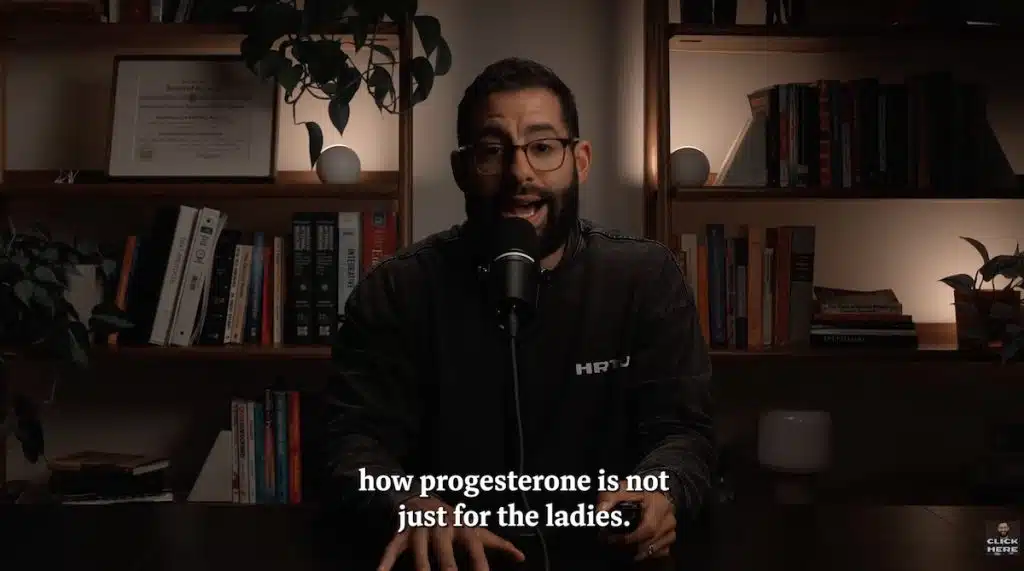
Progesterone is not just for reproductive health. It is a systemic hormone with profound effects on the immune system, brain, gut, and vascular health.
It modulates inflammation, balances cortisol, supports mitochondrial function, and restores equilibrium throughout the body.
That is why we spend so much time on this topic inside the HRTU Master Course.
Understanding progesterone’s broader impact is essential for anyone who wants to practice hormone therapy at a truly advanced level.
If you still think progesterone is only for the uterus, it is time to rethink that.
Progesterone is a vital hormone for the entire human organism, especially for women.
Conclusion: Beyond the Uterus, Beyond Reproduction
Progesterone is protective, restorative, and anti-inflammatory.
It helps women not only feel better but heal better.
When used correctly, it can transform lives — sometimes in ways that defy expectations.
Like Sam’s story.
And that is exactly why I believe every provider should understand the true power of progesterone.If you want to learn how to apply this clinically and safely, it all begins inside the HRTU Master Course.